
Last updated on
Oct 31, 2026

MA Form 5 free printable template
pdfFiller is not affiliated with any government organization

Fill out
Complete the form online in a simple drag-and-drop editor.

eSign
Add your legally binding signature or send the form for signing.

Share
Share the form via a link, letting anyone fill it out from any device.

Export
Download, print, email, or move the form to your cloud storage.
Why pdfFiller is the best tool for your documents and forms


End-to-end document management
From editing and signing to collaboration and tracking, pdfFiller has everything you need to get your documents done quickly and efficiently.
Accessible from anywhere
pdfFiller is fully cloud-based. This means you can edit, sign, and share documents from anywhere using your computer, smartphone, or tablet.
Secure and compliant
pdfFiller lets you securely manage documents following global laws like ESIGN, CCPA, and GDPR. It's also HIPAA and SOC 2 compliant.
What is MA Form 5
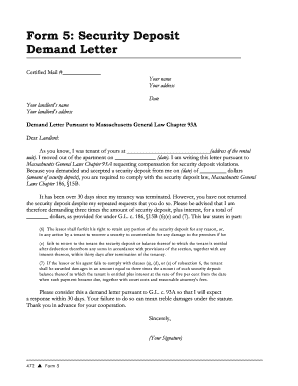
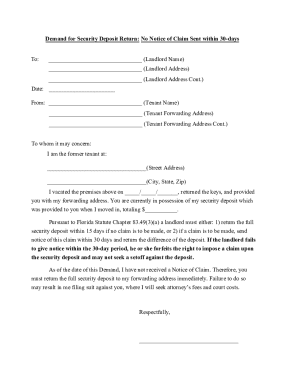
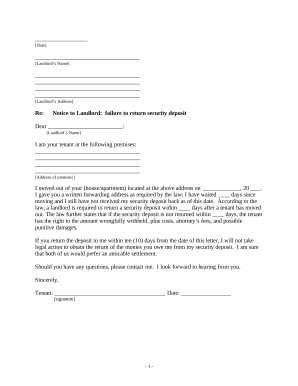
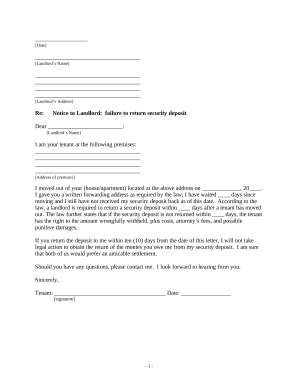
The Security Deposit Demand Letter is a legal notice used by tenants in Massachusetts to formally request the return of their security deposit from landlords who have not complied within 30 days.
pdfFiller scores top ratings on review platforms




I already have recommended PDF Filler to others! I would like to see a bit more of a robust text editor.
I use it for all kinds of paper work and to fill out papers that have been sent by email to me
Who needs MA Form 5?
Explore how professionals across industries use pdfFiller.

MA Form 5 is needed by:
-
Tenants seeking return of their security deposit
-
Landlords receiving deposit demand notices
-
Legal professionals assisting tenants in Massachusetts
-
Property management companies overseeing rental agreements
-
Consumers exploring tenant rights and obligations
-
Real estate agents advising tenants on legal forms
Comprehensive Guide to MA Form 5
1. What is a Security Deposit Demand Letter?
A Security Deposit Demand Letter is a formal request issued by tenants to reclaim their security deposit from landlords who have not returned it within the specified timeframe. In Massachusetts, this document serves a critical role under the Massachusetts General Laws Chapter 93A and Chapter 186, §15B. It emphasizes the rights of tenants seeking the return of their deposits, highlighting the necessity of this document in ensuring legal compliance from landlords.
-
This letter acts as a legal document to demand the return of the security deposit.
-
It is essential for tenants in asserting their rights under Massachusetts law.
2. Purpose and Benefits of the Security Deposit Demand Letter
Tenants should consider using the Security Deposit Demand Letter for several reasons. This letter not only encourages compliance from landlords but also establishes a legal footing for any claims regarding security deposits. If landlords fail to respond appropriately, tenants may potentially recover up to three times the deposit plus interest.
-
This letter enhances the likelihood of receiving the security deposit back without unnecessary disputes.
-
It outlines the legal basis for claims and informs landlords of their responsibilities.
3. Who Needs the Security Deposit Demand Letter?
This document is particularly relevant for tenants in Massachusetts who have vacated their rental units but have not received their security deposits. It is essential for individuals who understand their legal rights and the implications involved in not returning deposits. Knowing the eligibility criteria is vital for effective use of this document.
-
Tenants who have left their rental properties and seek to recover their deposit.
-
Individuals who are aware of their legal rights concerning security deposits.
4. When to Use the Security Deposit Demand Letter
The timing of submitting the Security Deposit Demand Letter is crucial to ensure a successful outcome. It is advisable to file the letter after the 30-day grace period post-tenancy termination. Submitting too late may hinder the ability to reclaim the deposit or diminish its recovery potential.
-
Filing should occur within the legal timeframe to maximize effectiveness.
-
Understanding the conditions for filing can influence outcomes significantly.
5. How to Fill Out the Security Deposit Demand Letter Online
Completing the Security Deposit Demand Letter is simplified through online platforms like pdfFiller. Essential fields that need to be filled in include both tenant and landlord information, details about the deposit, and signatures.
-
Each form includes fillable fields tailored for tenant and landlord details.
-
Reviewing the completed form is critical to eliminate common errors.
6. Submission Methods for the Security Deposit Demand Letter
Submitting the Security Deposit Demand Letter requires careful consideration of methods. Options include both physical mailing and electronic submissions, with certified mail and tracking being recommended for proof of delivery. Following up post-submission can ensure that landlords address the demand adequately.
-
Certified mail provides evidence of submission and can prompt compliance.
-
Tracking submissions can aid in confirming delivery to landlords.
7. Security and Compliance When Using the Security Deposit Demand Letter
When filling out and storing the Security Deposit Demand Letter, data security is paramount. Utilizing secure platforms like pdfFiller ensures that personal information remains confidential while also complying with legal standards such as GDPR and HIPAA.
-
pdfFiller employs advanced encryption methods to protect sensitive data.
-
Following best practices for document security can safeguard personal information.
8. How to Track Your Submission and Next Steps
Once the Security Deposit Demand Letter is submitted, tenants should actively track its status. Following up effectively with landlords can clarify the situation, and understanding the next steps is essential if a response is not received within the required timeframe.
-
Tenants should establish a protocol for following up on their submission.
-
If the landlord fails to respond, escalation options should be considered.
9. Utilizing pdfFiller for Your Security Deposit Demand Letter
pdfFiller serves as a valuable resource for tenants when processing their Security Deposit Demand Letter. Its user-friendly features streamline the document creation process, allowing users to edit, eSign, and securely share their letters without hassle.
-
Quick editing features make it easy to customize the letter.
-
Secure sharing options help keep documentation organized and accessible.
How to fill out the MA Form 5
-
1.Access pdfFiller and log in or create an account if you do not have one. Use the search bar to locate the Security Deposit Demand Letter form.
-
2.Once opened, review the document layout. Familiarize yourself with the required fields that need to be completed.
-
3.Gather all necessary information. This includes your name, address, your landlord’s name and address, the rental unit address, your security deposit amount, and your move-out date.
-
4.Begin filling out the form in pdfFiller. Click on each field to enter your personal details and related information appropriate to the demand letter.
-
5.Use the text box to input specific details, ensuring accuracy and completeness. Double-check entries for spelling and information accuracy to prevent any errors.
-
6.Look for the 'Certified Mail #' and 'Date' fields to include these critical details. These enhance the legitimacy of your notice.
-
7.If you need assistance, refer to the instructions included in the form. They guide how to complete the filling appropriately.
-
8.After filling in all required fields, review the entire document thoroughly to ensure everything is complete and correctly filled out.
-
9.Utilize pdfFiller's preview feature to see how your final document will appear once completed. Make necessary adjustments if needed.
-
10.Finally, save your form. You can also choose to download it as a PDF or submit it directly to your landlord through certified mail options provided by pdfFiller.

Who is eligible to use the Security Deposit Demand Letter?
Any tenant in Massachusetts who has not received their security deposit back within 30 days of moving out can use this letter to demand its return.
What should I do if my landlord does not respond to the demand letter?
If your landlord does not comply with the demand within 30 days, you may have the right to pursue further legal action, including potentially suing for three times the deposit amount plus interest.
How do I submit the completed Security Deposit Demand Letter?
Once completed, the letter should be sent to your landlord via certified mail to ensure proof of delivery. Utilize the fillable 'Certified Mail #' field for tracking.
What supporting documents might I need with this form?
While no additional documents are required to submit the Security Deposit Demand Letter, keeping records of your lease, move-out date, and previous communications with your landlord may be beneficial.
Are there common mistakes to avoid when filling out the Security Deposit Demand Letter?
Common mistakes include failing to provide correct landlord information, omitting your signature, and neglecting to note the return deadline for your deposit. Always double-check your entries.
Is notarization required for the Security Deposit Demand Letter?
No, notarization is not required for the Security Deposit Demand Letter in Massachusetts, but ensure your signature is included.
What are the time-sensitive aspects associated with this letter?
The letter must be sent within 30 days after your tenancy ends and your security deposit should be requested accordingly. If your landlord does not respond within this timeframe, legal action may be initiated.
Related Content
Related Forms



Related Catalogs
Get the latest insights from our blog


If you believe that this page should be taken down, please follow our DMCA take down process
here
.
This form may include fields for payment information. Data entered in these fields is not covered by PCI DSS compliance.